The Art of Ebru
Ebru
Clouded paper
Turkish marbled paper
Suminagashi 墨流し
Abr-o-bād ابر و باد
Ebru goes by various names – clouded paper, Turkish marbled paper, suminagashi (墨流し) – ‘floating ink’ in Japanese, abr-o-bād (ابر و باد) – ‘cloud and wind’ in Farsi, or simply marbled paper. The Turkish word Ebru likely comes from the Persian abrī (ابری), ‘cloudy’. Despite the differences in painting techniques, they all share one essential element – the colours are skilfully placed on water.

History
A journey across centuries
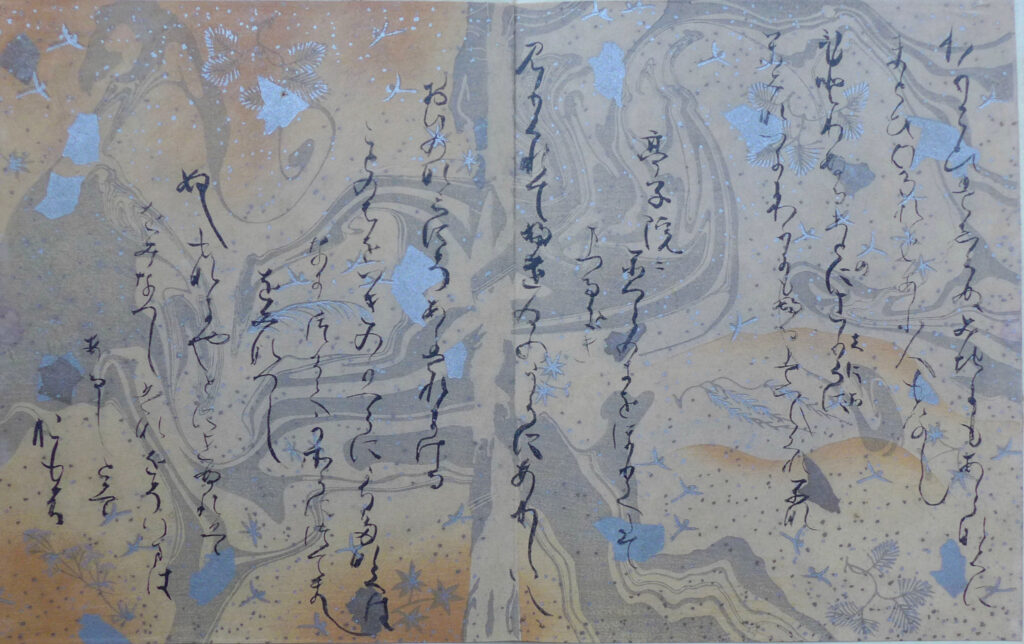
Two pages of waka poems by Ōshikōchi no Mitsune from the Sanjūrokunin kashū, presented to Emperor Shirakawa on his sixtieth birthday in 1112. Nishi Hongan-ji, Kyoto. Source: Wikimedia Commons, public domain.
These pages from Japan are the oldest examples of marbled paper known today. The Ebru technique as we know it developed in the 15th century in Greater Iran and Central Asia. Persian history books mention “kāghaẕ-e abrī” or “abrī” as its early names. In the 15th and 16th centuries, various Ebru techniques and materials emerged in Persia and in the regions of present-day Türkiye.
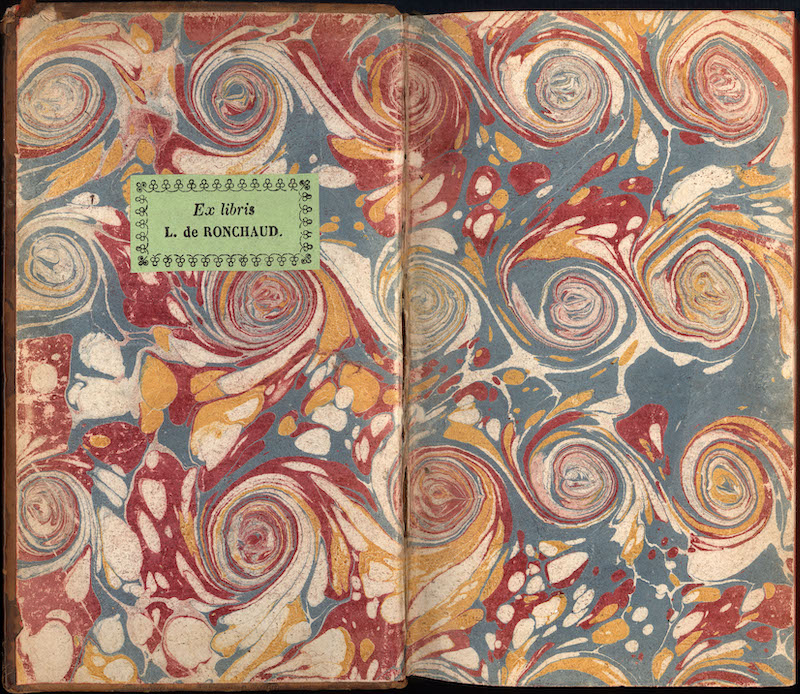
Marbled endpaper from a book bound in France around 1735. Source: Wikimedia Commons.
In the 17th century, marbled paper reached Europe and became popular for book covers and endpapers. Over time, many methods emerged, where colours were floated on a bath of thickened liquid, also called size. It was made from plants such as fenugreek seeds, tragacanth gum (Astragalus) and salep (tubers of Orchis mascula).
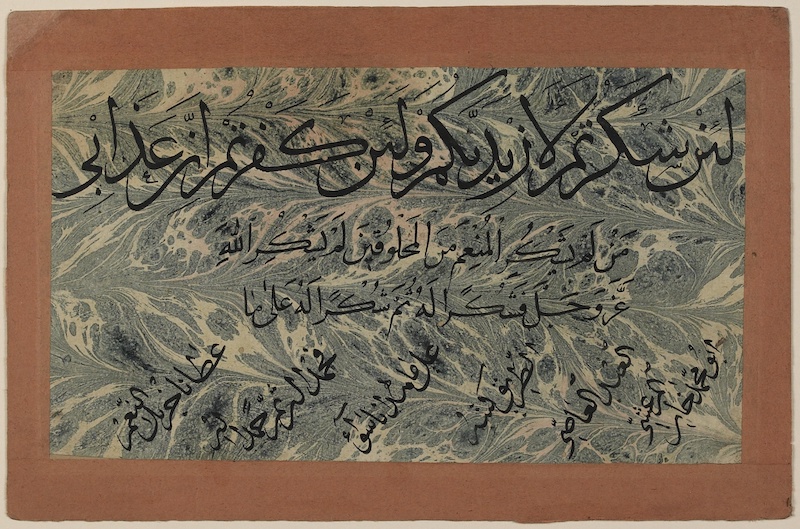
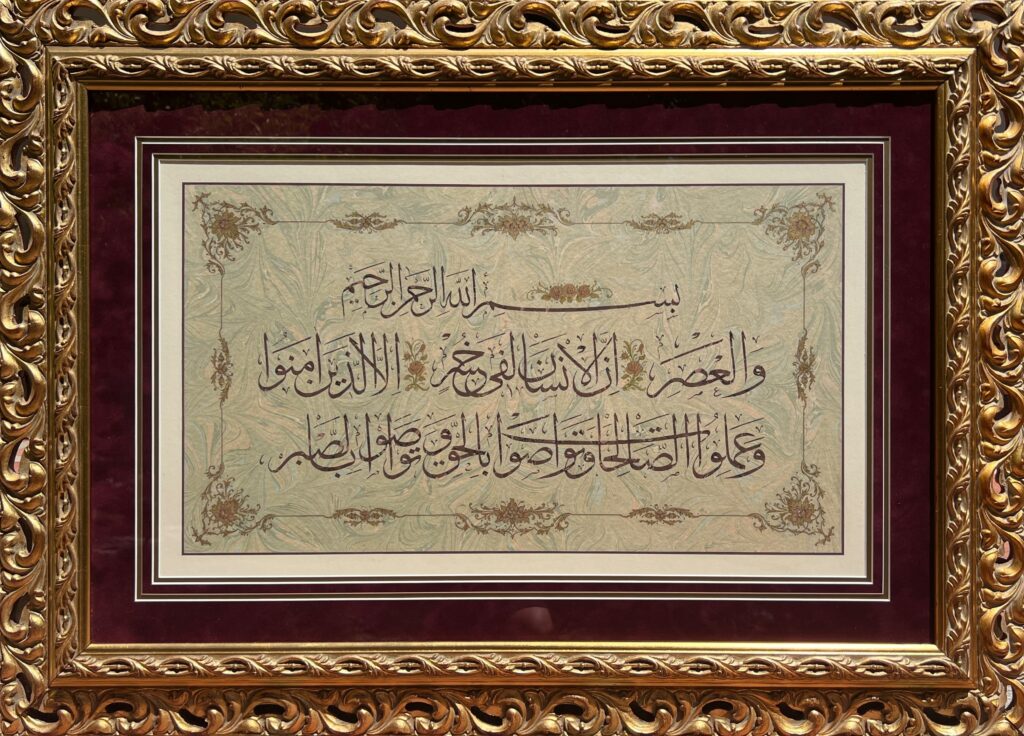
Calligraphic panel with a verse from the Qur’an (14:7) on marbled paper. Source: Library of Congress.
This calligraphic panel is typical of compositions written on marbled paper after the 16th century in Central Asia, Iran, India and Türkiye.
Alongside these traditional uses, artists today explore Ebru as a painting technique. It is shown at international symposiums and museum exhibitions, and its origins are still being researched.
Culture
Passed on from master to apprentice
Ebru is part of Turkish culture, identity and way of living. It is not only a technique but also a philosophy, passed on from one generation to the next – part of a collective identity and memory. In 2014, “Ebru, Turkish art of marbling” was added to the UNESCO list of Intangible Cultural Heritage.
Ebru artists learn for years from a master before they develop their own techniques and even create their own materials.
What’s special
The magic of Ebru
Coexistence of colours
The colours do not mix on the water. Today, Ebru stands for the diversity of the cosmos: all colours form one fascinating unity, without one dominating or pushing away the other.
Unique artwork
Creating art on water depends on many things – the mix of colours, the temperature, the speed of the hand, even dust on the surface. No piece can be repeated, and harmony between body and mind is essential.
Interplay
Mastering the colours on water takes years of practice. Planned or by chance, the interplay creates beautiful motifs. Even when the result is not perfect, the dance of colours becomes a meditative journey.
Material
What I work with
Paint
For centuries, Ebru has used natural pigments from rocks and soil that resist water. The paint is mixed with water and ox gall and rests for one to two months, with regular stirring. Proper soaking makes sure the colours stick to the paper.
Carrageenan
Ebru needs a thick, slightly sticky liquid. Today, the most common base is carrageenan, extracted from red seaweed. Traditionally, tragacanth gum (kitre) was used.
Ox gall
Ox gall lets the colours spread on the surface without sinking. It regulates the surface tension and keeps the colours from mixing. The first colours need only a little gall; each new colour needs more. Unbalanced colours sink, break or smear when transferred to paper.
Combs and needles
Combs create comb patterns, with different distances between the teeth (2, 3, 4, 5, 6, 7 and 9 mm). Every artist adapts their combs to their own style. Needles of different sizes, made for example from nails, wire or sewing needles, are used to draw fine lines and details.
Tray
A stainless steel tray holds the liquid. It is usually about 6 cm deep and comes in sizes of 68 × 100 cm, 34 × 50 cm and 17 × 25 cm.
Brush
Ebru brushes are made by hand from horsehair and dried rose branches, tied with fishing line – without glue or ribbon. Over time, the hairs bend into a soft curve, which gives precise control over the direction of the drops.
Turpentine
Natural turpentine gives the colours a three-dimensional, spherical effect.
